Top Signs You Need Garage Door Service – Don’t Ignore These
The signs a garage door needs service aren’t vague. They’re specific mechanical signals that point to a specific component under stress: a force-setting drift in the opener, a fraying cable, a torsion spring that’s lost tension, a track that’s shifted out of plumb. Learning to read those signals is the difference between a small adjustment now and a burned-out motor or a snapped spring later. If you’d rather not diagnose it yourself, call (855) 522-0573 and we’ll take a look.
A door that takes two seconds longer to close than it did six months ago isn’t “getting old.” It’s the opener’s force setting drifting while it works harder against friction from a cable that’s starting to fail. That’s the pattern we see most: a small mechanical problem quietly compounding until it becomes an emergency. This guide walks through the signals worth paying attention to, what each one usually means, and a monthly check you can run in about five minutes to catch trouble while it’s still cheap to fix.
What Are the Most Common Signs You Need Garage Door Repair?
The most common signs are a door that moves unevenly or reverses on its own, grinding or popping sounds during travel, a visible sag or gap at the bottom, and a remote that’s lost range. Each of these maps to a different part of the system, which is why a proper diagnosis matters. In Norfolk, we also see seasonal patterns: summer humidity swells wood panels and expands metal tracks, then cooler weather shrinks them back, and hardware that’s been in service for years starts showing white oxidation before it turns to visible rust.
Here’s how the signals break down by component:
- Uneven travel or a door that binds: usually a track that’s out of alignment, a roller that’s worn flat, or a cable that’s jumped its drum. Left alone, the opener pushes harder to compensate, and the motor or gear wears out trying.
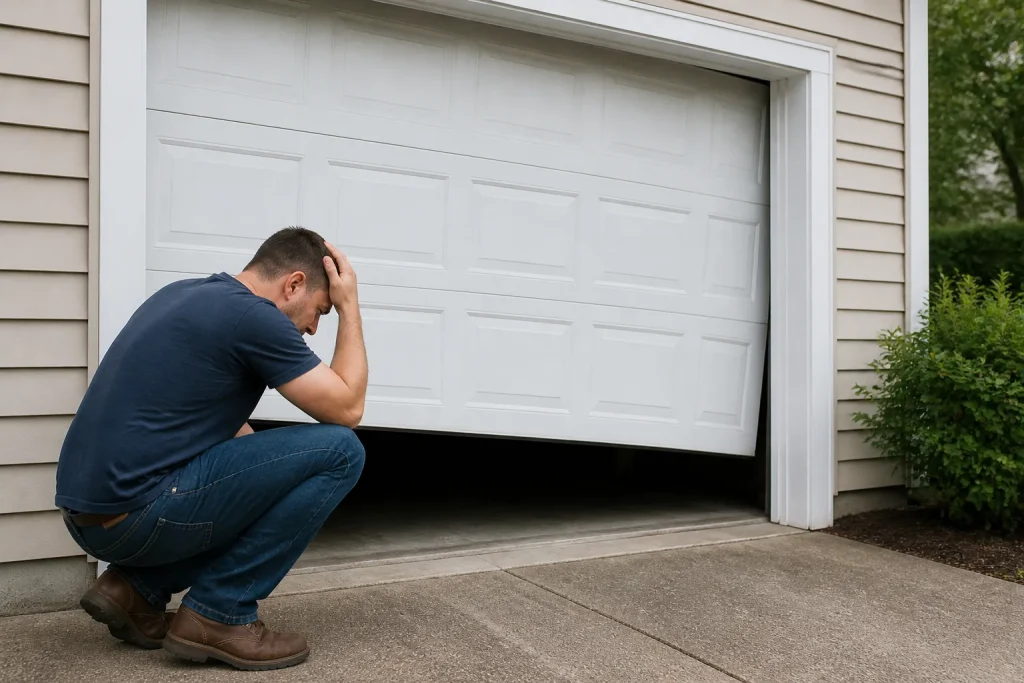
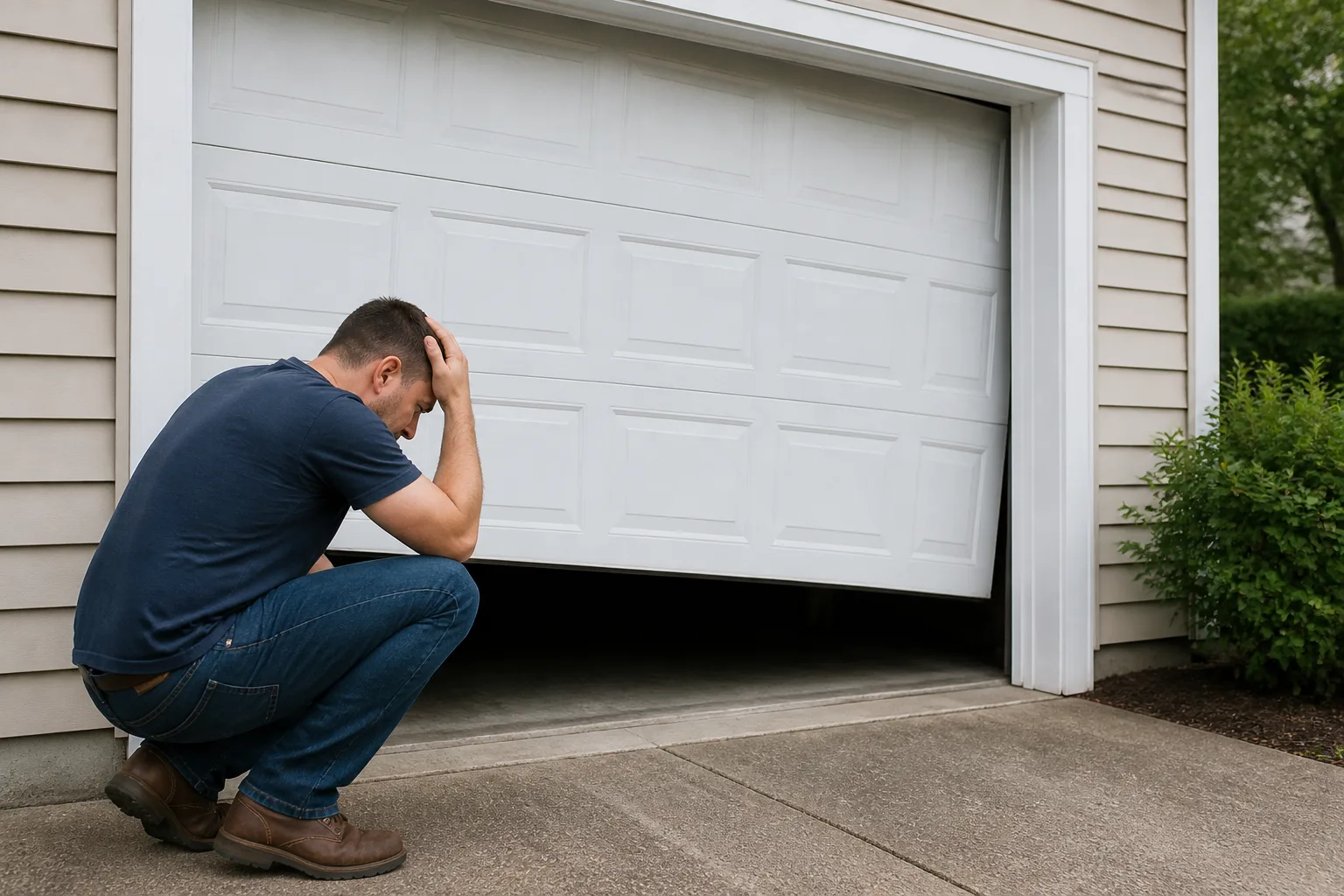
- A visible gap or sag at the bottom: a sign the door’s balance is off, often because a spring has lost tension. An unbalanced door is heavier than the opener is designed to lift.
- White chalky residue on hinges and springs: early oxidation. It shows up before rust does, especially on hardware that’s been through many humid Norfolk summers.
- A door that won’t stay fully closed: often a limit switch or travel-setting issue in the opener, not a door problem at all.
We work on systems from Amarr, Wayne Dalton, Craftsman, and Raynor, among others, and the diagnostic approach is the same across all of them: find the actual cause before quoting a fix. That’s the core of our garage door repair work.
What Do Abnormal Garage Door Sounds Actually Tell You?
Different sounds point to different failing components, and the sound is often the earliest warning you’ll get. A single loud bang from above the door usually means a torsion spring has snapped. A rhythmic scraping means a roller or hinge is worn. A grinding that builds as the door rises points to the opener’s gears or a dry, failing bearing. Learning to match the sound to the part saves guesswork.
Here’s what to listen for:
- A sharp bang, then the door won’t lift: torsion spring failure. Stop using the door and call for spring repair. This is the one repair you should never attempt yourself. Torsion springs store enormous tension, and the hardware that holds them can cause serious injury if it lets go without the right tools and training.
- A scraping or metal-on-metal rasp: a roller that’s seized or a hinge that’s worn through. Cheap to replace early. Left alone, it chews into the track and turns a small fix into a bigger one.
- A grinding that gets louder as the door rises: often the opener’s drive gear or a dry bearing. On a chain-drive opener this can also be a chain that’s too loose.
- A rattle or clunk at the start and end of travel: loose mounting hardware or a door that’s out of balance, so the opener is fighting the door’s weight.
- A high-pitched squeal: usually a dry torsion spring or roller that needs lubrication, not replacement.
Sound is diagnostic. If you can describe where in the door’s travel the noise starts, you’ve already narrowed down the likely culprit, and that speeds up the visit.
What Do Opener Behavior Signals Mean (And Why Homeowners Miss Them)?
Most opener problems get blamed on the remote battery, but a remote with reduced range, an opener that hesitates before moving, or a door that reverses with nothing in its path are usually logic board, travel-limit, or safety-sensor issues. These signals matter because an opener that’s reversing without an obstruction is a safety concern, and one that hesitates is often straining against a door it can’t lift cleanly.
Watch for these opener behaviors:
- Reduced remote range: sometimes the battery, but often a failing receiver or an antenna wire that’s been pinched. If a fresh battery doesn’t fix it, the opener is telling you something.
- Reversing with no obstruction: the safety sensors are misaligned or dirty, or the logic board is reading a false signal. Don’t ignore this one. A door that reverses unpredictably is a hazard.
- Hesitation at the start of travel: the opener is working against excess resistance, usually from a door that’s out of balance or a track that’s binding.
- The door stops partway and won’t finish: a travel-limit setting that’s drifted, or a force setting that’s been tripped by a heavier door.
- Lights flicker or the opener clicks without moving: often a capacitor or logic board fault, common on older units.
We handle opener diagnostics across LiftMaster, Chamberlain, Genie, and Craftsman platforms, so we know the specific failure patterns for each. When the opener itself is the problem, our garage door opener repair covers the repair or replacement. Norfolk humidity also plays a part: condensation can build up inside opener housings, and on units mounted in garages that stay damp, that moisture eventually finds the circuit board.
Why Spring and Cable Problems Are the Ones You Can’t Ignore
Springs and cables carry the door’s entire weight, so a failure in either one is a safety issue, not a convenience issue. A torsion spring that’s lost tension, a cable that’s frayed or jumped its drum, or an extension spring with a visible gap where a coil should be all mean the door is no longer safely balanced. Stop using it and call a trained technician. This is the single most dangerous repair in the trade and the one where professional help matters most.
What to look for on a visual check:
- A gap in a torsion spring’s coils, or a spring that looks stretched compared to where it sat before
- Frayed or kinked cables, especially near the drum at the top corners
- A door that feels much heavier than it used to when you lift it by hand (only test this with the opener disconnected and the door fully closed)
- White or rust-colored oxidation on spring hardware, which in Norfolk’s humid summers often shows up on the hardware before it shows up on the panels
If a spring or cable is compromised, we recommend leaving the door down until a technician can get to it. Spring repair is a dedicated service for us, and our technicians have up to 15 years of experience with both torsion and extension systems.
A Monthly 10-Point Garage Door Inspection You Can Do Yourself
A monthly visual check catches most early-stage failures before they cascade, and it takes about five minutes. Run it with the door closed and the opener disconnected if you’re comfortable doing so. This is a look-and-listen inspection, not a repair. Anything that requires tools or getting near a spring or cable is a job for a technician.
- Look at the springs: check for gaps, stretching, or oxidation on the coils. Don’t touch them.
- Check the cables: look for fraying or kinks, especially near the drums at the top corners.
- Inspect the tracks: they should be straight and parallel. Look for dents or a track that’s pulled away from the frame.
- Test the balance: with the door closed and the opener disconnected, lift it halfway. It should hold there. If it drops or feels very heavy, the springs need attention.
- Check the rollers: they should spin freely and look round, not flat-spotted or cracked.
- Look at the hinges: tight, no rust-through, no missing screws.
- Test the safety sensors: wave an object across the beam. The door should reverse.
- Listen for new sounds: note where in the travel any grinding or scraping starts.
- Look at the weather seal: a worn seal lets in water and pests, and on wood doors it’s the first place humidity damage shows.
- Check the opener housing: look for condensation or moisture inside the unit, common in damp Norfolk garages.
If anything on this list looks off, note it and call. Early adjustment is far cheaper than an emergency repair, and it’s usually the difference between a small fix and a full component replacement.
When to call a pro: anything involving springs, cables, or the opener’s electrical components. Those aren’t DIY jobs, and we’d rather you call us than risk an injury. If you’re weighing a repair against a replacement, our garage door installation service covers that conversation, and we’ll tell you honestly which makes more sense.
Related services in Norfolk: spring repair, opener repair, and full installation are all handled by the same team, so you don’t need to call a second company if a repair turns into a replacement.
The Bottom Line
The warning signs of garage door failure are specific, and they map to specific parts. A door that hesitates, reverses without obstruction, grinds, bangs, sags, or shows oxidation on its hardware is telling you exactly which component is under stress. Catching those signals early is the difference between a modest adjustment and a much larger repair. Norfolk’s humidity adds its own layer: seasonal binding, condensation in opener housings, and oxidation that shows up before rust does. A five-minute monthly check is the cheapest insurance you have.
If you’re in Norfolk and need help reading those signals, Garage Door Repair Norfolk Pros offers free estimates – call (855) 522-0573. We work on all the major brands, diagnose the actual cause, and quote the price before any work starts.
Frequently Asked Questions
The first sign is usually a change in how the door moves or sounds: it hesitates at the start of travel, runs unevenly, or makes a new grinding or scraping noise. Any of those means a component is under stress. Call (855) 522-0573 for a free estimate.
No. Torsion and extension springs store enormous tension, and the hardware that holds them can cause serious injury without the right tools and training. Spring repair is a job for a trained technician. Call us and we’ll handle it safely.
A door that reverses with no obstruction usually has misaligned or dirty safety sensors, or a logic board reading a false signal. It’s a safety concern, so don’t ignore it. Call (855) 522-0573 and we’ll diagnose it.
Once a month is a good rhythm for a quick visual check of springs, cables, tracks, rollers, and the opener, plus a test of the safety sensors. It catches most early-stage problems before they turn into an emergency. If something looks off, call (855) 522-0573 for a free estimate.
Written by the team at Garage Door Repair Norfolk Pros.
Need Garage Door Help?
Call Garage Door Repair Norfolk Pros - the local pro we connect you with is licensed and insured, here with fast after-hours help in Norfolk.
(855) 522-0573