Garage Door Repair: Repair or Replace? How Norfolk Homeowners Decide
Most Norfolk homeowners assume age settles the question. It usually doesn’t. A 15-year-old door with one tired spring is almost always worth fixing. A 7-year-old door with a cracked bottom panel, corroded cable drums and an opener on its last circuit board often isn’t. We see this every week in Norfolk: the number on the installation sticker tells you far less than the condition of the parts in front of you. What matters is structural integrity, parts availability for your specific system, and what repeated repairs will keep costing you.
If you’d rather have someone knowledgeable look at it than guess, call (855) 522-0573 and we’ll talk it through.
Key Takeaways
- Age alone is a poor guide. Score each component (springs, cables and drums, track, panels, opener) on its own condition before deciding.
- Doors mounted close to the Chesapeake Bay or around Ocean View tend to wear hardware faster, which changes the repair-versus-replace math.
- If your opener or panel profile is discontinued, continued repair can cost more than a replacement over a few years.
- Panel damage that weakens tension across the spring system is a mechanical problem, not a cosmetic one.
- When the running total of repairs approaches the cost of a new door, replacement is the financially sounder call.
Why age is the wrong first question
The honest answer is that a garage door is not one object. It’s a system of parts that wear at completely different rates. A door that’s a decade and a half old might still have a solid track, straight panels and an opener running fine. A much newer door could have a bottom section that’s cracked, cables fraying at the drum, and a logic board that’s started acting up. Judging both by age would send you to the wrong decision on each.
Before anything else, understand what’s actually failing. The spring system does the lifting, cables and drums transfer that lift to the door, the track keeps everything aligned, and the opener provides the push and pull. Each of those can age independently. In our experience across Norfolk, the doors that get replaced too early usually have one dead component and four healthy ones. The doors that get repaired too long usually have several tired components and a homeowner hoping the next fix is the last. Neither is a smart way to spend money.
Narrow the question down: what, specifically, has stopped working today? That single answer tells you more than the install date ever will.
The component-by-component framework we use
When we assess a Norfolk door, we score five systems separately, then combine them into one recommendation. You can do the same visual and functional check on your own before calling anyone.
- Spring system. Torsion or extension springs carry the door’s weight. Rust, stretch, gaps and a door that slams down all point to springs near the end of their life. One broken spring on a otherwise healthy door is a repair, full stop.
- Cables and drums. Look for fraying, kinks and rust at the drum. Cables are inexpensive parts but a serious safety item. Deteriorating drums are a sign the whole lifting system has been working too hard.
- Track. Bent or badly misaligned track can often be corrected. Track that’s pulling away from the door frame or heavily rusted is a bigger signal.
- Panels. A single dent is cosmetic. A cracked, split or separating bottom panel is structural, and we’ll come back to why that matters.
- Opener. A fading motor, a remote that won’t pair, or a unit that stutters under load tells you the mechanical side may outlive the electric side.
Score each one: healthy, tired, or failing. Then read the pattern. Three healthy systems and two failing are usually a repair. Three or more failing means you’re looking at a door that’s already most of the way to replacement anyway.
This is where brand matters, too. A technician who works across Amarr, Wayne Dalton, Craftsman and Raynor systems will know which parts are common and which are proprietary, which changes the cost picture.
The Norfolk factor: what the water does to your hardware
Norfolk sits right against the Chesapeake Bay, and homes near the water around Ocean View and the bay-facing neighborhoods see hardware wear faster than inland properties. Metal parts that live in humid, moisture-heavy air corrode sooner, and corroded springs, cables and drums fail earlier than the same parts on a drier lot. That’s not marketing talk. It’s the reason two identical doors installed the same year can be in very different shape depending on where in Norfolk they sit.
What that means for your decision:
- If your hardware is showing rust across several components at once, the wear is likely environmental and ongoing. Replacing tired parts with the same grade may mean repeating the job sooner than you’d like.
- A door that’s still structurally sound but has heavily rusted cables, drums and springs may still be worth repairing, provided the panels and track are healthy.
- If the whole mechanism is corroding together, replacing it once usually costs less over time than chasing rust from part to part.
Before you write off a door near the water, look at the metal, not the year. If bolts, drums and hinges are rust-stained, that tells you more about lifespan than anything on a label.
When parts availability decides for you
Sometimes the honest answer is that repairing makes no economic sense even though the door still opens. That happens when the parts are hard or impossible to get.
Some older openers have discontinued logic boards and remotes, so a repair becomes a hunt for used or aftermarket components that may or may not work. Some door manufacturers stop producing certain panel profiles, which means a single damaged section can’t be matched. In those cases, a door that “still works” is one failure away from a much bigger bill, and the money you’d spend chasing obsolete parts goes a long way toward a replacement that’s supported for years to come.
Brand-specific diagnostics help here. A tech who works across LiftMaster, Chamberlain, Genie and Craftsman openers and across multiple door manufacturers can tell you quickly whether your exact system is still supported. That single answer can settle the repair-or-replace question faster than any cost comparison. If a repair is viable, that’s what we recommend. If it isn’t, you deserve to know before you spend on it.
The structural threshold: when a panel repair masks a bigger problem
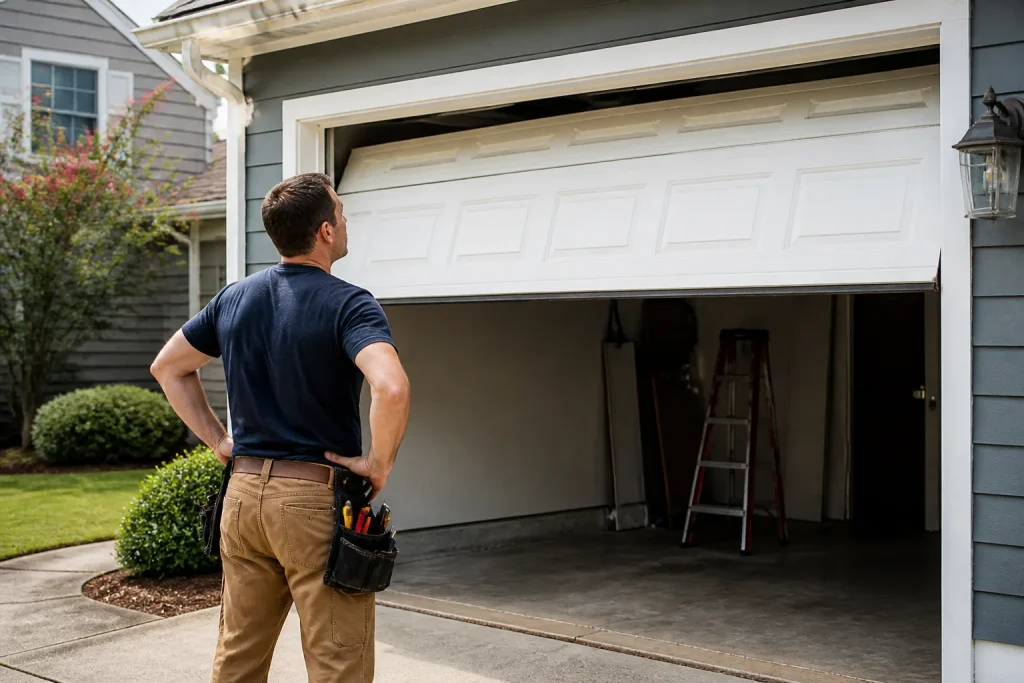
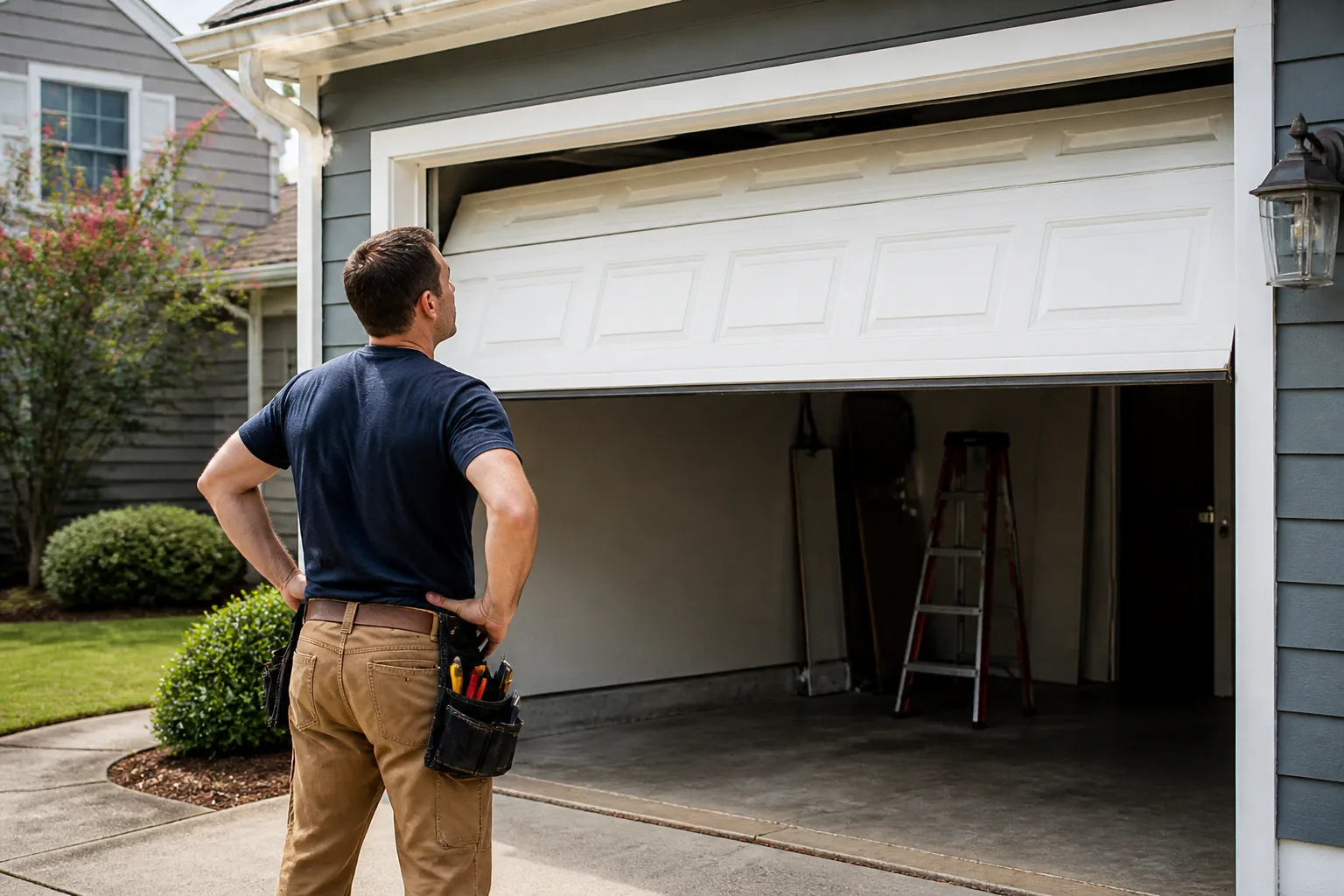
Here’s the part most homeowners don’t hear. A cracked or separating bottom panel isn’t just ugly. It changes how the door holds tension across the spring system. When a panel loses rigidity, the door flexes under load, the cables and drums take on uneven strain, and the whole lifting mechanism works harder than it was designed to. Patching or caulking the panel can hide the crack while the mechanical wear underneath keeps getting worse.
So when a panel problem shows up, ask whether it’s cosmetic or structural:
- Cosmetic: dents, scuffs, minor surface damage. Repair or leave it.
- Structural: cracks, splits, separation, a bottom section that bows under load. This is a mechanical issue, and masking it with a surface fix usually costs more later.
If the damage is structural and the rest of the door is already worn, replacement is the honest call. If the rest is healthy, panel work can be worth it, and a proper diagnosis tells you which side you’re on. Either way, if you’d rather have a trained eye make that call, that’s what we’re here for: garage door repair includes a full check of the spring system, cables, track and panels before we recommend anything.
The cumulative repair cost rule for Norfolk pricing
No single repair figure decides this, but a running total does. Keep a mental ledger of what you’ve spent on that door over the last few years. If repairs are stacking up on the same door, and the next one isn’t far behind, that’s your signal. As a general rule of thumb: when the total of recent repairs starts approaching the cost of a new door, stop repairing and replace.
Your exact numbers depend on your door, but here’s the logic:
- One isolated repair on a healthy door is money well spent.
- A second repair on a different system soon after is a yellow light. Look at whether the mechanism is wearing as a whole.
- A third repair in a short window means you’re funding a failing door piece by piece, and replacement usually costs less over the next several years.
If your door’s mechanism needs more than parts, that’s where garage door installation becomes the better financial decision, and we can tell you which side you’re on before you commit to either.
When to call a pro (and what not to touch)
Some of this you can assess yourself. Some you shouldn’t touch. The spring system is the single most dangerous part of the door. Torsion springs are under extreme tension, and a wrong move can cause serious injury. We don’t give step-by-step DIY guidance on springs and cables, and we’d urge you to leave those to a trained technician. If you hear a loud bang from the garage and the door won’t lift, the spring has likely failed, and it’s time to call.
Call us when you’re:
- Hearing a snap or bang and the door won’t open
- Seeing a visibly broken or stretched spring
- Dealing with frayed or rusted cables
- Getting a door that’s stuck open or stuck closed, which is a security issue as much as a mechanical one
- Unsure whether a repair or replacement makes sense and you want an honest, parts-based answer
Emergency service is part of what we offer, so a stuck door doesn’t have to wait. And if the problem turns out to be the opener itself, not the door, we handle garage door opener repair across LiftMaster, Chamberlain, Genie and Craftsman platforms so you’re not sent to a second company to sort it out.
Related services in Norfolk: for anything from a single broken spring to a full replacement, Garage Door Repair Norfolk Pros covers the whole scope under one provider, with brand-specific diagnostics so the fix matches your actual system.
The Bottom Line
Age is the wrong question. Condition, parts availability and cumulative cost are the right ones. A healthy door with one broken spring is a repair. A young door with corroded hardware and an opener on borrowed time is usually a replacement. Doors near the bay wear faster, discontinued parts tilt the math toward replacing, and panel damage that affects tension is structural, not cosmetic. Score each component, add up what you’ve already spent, and let that pattern make the call.
Our technicians have up to 15 years of experience working across the major brands, and we approach it repair-first, replace only when necessary. If you’re in Norfolk and want a straight answer, Garage Door Repair Norfolk Pros offers free estimates. Call (855) 522-0573 for a free estimate and we’ll tell you what your door actually needs.
Frequently Asked Questions
It depends on the condition of each component, not the door’s age. If only the springs or opener are failing, repair is usually the right call. If several systems are worn, hardware is heavily corroded from humidity near the bay, or parts are discontinued, replacement is usually the sounder financial decision. A component-by-component check tells you which side you’re on.
Warning signs include a loud bang from the garage, a door that feels extremely heavy or won’t lift, a visible gap or stretch in the spring, and rust along the coil. Torsion springs are under extreme tension, so don’t attempt to adjust or remove them yourself. Call (855) 522-0573 and we’ll take a look.
Humidity and moisture near the water accelerate corrosion in springs, cables, drums and hinges, so hardware on homes around Ocean View and the bay-facing neighborhoods tends to wear faster than inland doors. That doesn’t mean you must replace immediately. It does mean checking the metal, not just the age, when you make the call.
Sometimes, if your panel profile is still available and the damage is cosmetic. If the panel is cracked or separating, the door can lose rigidity and strain the spring system, which makes it a mechanical problem, not just a cosmetic one. We can tell you whether a panel replacement is viable for your exact door. Call (855) 522-0573 for a free estimate.
Written by the team at Garage Door Repair Norfolk Pros.
Need Garage Door Help?
Call Garage Door Repair Norfolk Pros - the local pro we connect you with is licensed and insured, here with fast after-hours help in Norfolk.
(855) 522-0573